Author Archive
Question: What’s the difference between a CTA and a TFC Reverse Osmosis membrane?
Posted by: | CommentsAnswer:
A CTA (Cellulose Triacetate) membrane is a paper by-product membrane bonded to a synthetic layer. Due to its cellulose composition, a CTA membrane requires chlorine in the water source to keep bacteria from forming on it. A CTA membrane has a rejection rate of between 85 – 94%. CTA membranes have an average life expectancy of 18 to 24 months and are considered inferior to TFC membranes. We offer only TFC (Thin Film Composite) membranes which are made of a synthetic material. A TFC membrane requires the chlorine to be removed prior to the water entering the membrane. A TFC membrane has a rejection percentage rate between 95 – 98% which is much higher than the CTA membrane. A TFC membrane will last between 2 – 5 years. Many hospitals use TFC membranes in their hemo-dialysis (Kidney) machines because of the higher purity water they produce.
Question:What are the Benefits of a Reverse Osmosis Pressure Gauge Kit?
Posted by: | CommentsAnswer:
Background
Most Reverse Osmosis owners are concerned about when to replace the filters on their RO system. A Pressure Gauge will provide them with a heads-up as to when the filters are nearing depletion.
What are the Benefits of using a Pressure Gauge Kit
1) Pressure drop on the gauge kit identifies when to replace your pre-filters.
2) Properly maintained pre-filters will extend the life of your Reverse Osmosis membrane.
3) Knowing the incoming PSI on your RO system will permit you to better manage the efficiency of your Reverse Osmosis system and thereby reduce the amount of water you will send to the drain and increase the amount of permeate water going to the storage tank.
4) Reverse Osmosis systems with Booster Pumps installed will be able to read the PSI on the gauge to know what pressure setting they have on their Booster Pump switch.
Please review the articles below for additional information on this RO Pressure Gauge Kit.
1) How does a Pressure Gauge work on my Reverse Osmosis system?
2) How do I install a pressure gauge on my Reverse Osmosis system?
3) How do I know when to replace my Reverse Osmosis Pre-Filters?
Question: How does a Pressure Gauge work on my Reverse Osmosis system?
Posted by: | CommentsAnswer:
Background
Most Reverse Osmosis owners are concerned about when to replace the filters on their RO system. A Pressure Gauge Kit will provide them with a heads-up as to when the filters are nearing depletion.
How It Works
1) A pressure gauge kit will tell you the PSI of the water as it enters your Reverse Osmosis membrane housing.
2) Check the PSI on this gauge when your pre-filters are new – be certain to record the PSI number and the date. Then check in 3 months or 6 months and note the change in the PSI.
3) When the PSI reading on your gauge has dropped 6 or 8 points (example – from 60 down to 52 PSI) you need to order new filters. As the PSI drops below 50 PSI, you are beginning to send a greater percentage of water to the drain and less water to the storage tank. When the reading reaches 45 PSI, you will notice a big increase in drain flow.
Please review the articles below for additional information on this RO Pressure Gauge Kit.
1) What are the Benefits of a Reverse Osmosis Pressure Gauge Kit?
2) How do I install a pressure gauge on my Reverse Osmosis system?
3) How do I know when to replace my Reverse Osmosis Pre-Filters?
Question: How do I install a pressure gauge kit on my Reverse Osmosis system?
Posted by: | CommentsAnswer:
Background
Most Reverse Osmosis owners are concerned about when to replace the filters on their RO system. A Pressure Gauge Kit will provide them with a heads-up as to when the filters are nearing depletion.
How do I Install this Pressure Gauge Kit
Installation of a RO Pressure Gauge Kit is not difficult and will only take about one minute.
1) If your RO system is on city water or well water (without a Booster Pump), locate the 1/4″ tubing (usually it is RED) between the final pre-filter and where the tubing enters the ASO valve.
2) Cut the tubing (take care to cut it square – not at an angle).
3) Insert one end of the tubing into the male connector on the pressure gauge kit and the other end of the cut tubing is to be inserted into the male connector on the opposite side of the gauge kit. HEY – you’re already done.
4) On Reverse Osmosis systems with Booster Pumps installed, locate the Pressure Gauge Kit between the outlet port on the Booster Pump and the inlet on the ASO valve.
5) Should you have a Reverse Osmosis system with a Booster Pump already installed, you would locate the pressure gauge kit between the outlet port on the Booster Pump and the inlet fitting on the ASO valve.
6) In # 2 above we noted how to check the PSI on your system when the pre-filters are new and then again 3 months later. With a Booster Pump installed, when you test the PSI after the pre-filters, it is best (more accurate) to unplug the Booster Pump and measure the PSI based on the water pressure without the Booster Pump. The efficiency of the Booster Pump will overcome some of the loss of PSI caused by pre-filter depletion and therefore you will not get an accurate signal as to when you should change the pre-filters.
Please review the articles below for additional information on this RO Pressure Gauge Kit.
1) What are the Benefits of a Reverse Osmosis Pressure Gauge Kit?
2) How does a Pressure Gauge work on my Reverse Osmosis system?
3) How do I know when to replace my Reverse Osmosis Pre-Filters?
Question: How do I know when to replace my Reverse Osmosis Pre-Filters?
Posted by: | CommentsAnswer:
Background
Most Reverse Osmosis owners are concerned about when to replace the filters on their RO system. A Pressure Gauge will provide them with a heads-up as to when the filters are nearing depletion.
Most Reverse Osmosis pre-filters are replaced based on a time schedule. They mark the calendar to change the pre-filters every 6 months or once a year. A more accurate method is to use a pressure gauge kit and note the change in the PSI coming from the pre-filters. When the PSI begins to drop compared with the PSI when the pre-filters were new, this is a clear indication that the pre-filters are beginning to deplete and when the PSI has dropped 6 or 8 PSI points, you should replace the pre-filters. A Reverse Osmosis Pressure Gauge Kit will take the guess work out of when to replace your filters.
The articles listed below will provide additional information on RO Pressure Gauge Kits:
1) What are the Benefits of a Reverse Osmosis Pressure Gauge Kit?
2) How does a Pressure Gauge work on my Reverse Osmosis system?
3) How do I install a pressure gauge on my Reverse Osmosis system?
Question: How much space do I need for a dual Big Blue Whole House water filter?
Posted by: | CommentsAnswer:
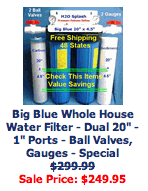
A dual Big Blue Whole House water filter system is a big unit , but it will also do a “Big Job”. This system is designed to achieve;
1) little or no impact on the flow
2) provide high quality water to the entire house
3) large filters provide extended life between filter changes
These systems are available with 20″ x 4.5″ filters and 10″ x 4.5″ filters plus options such as ball valves (to make filter changes easy), pressure gauges (to take the guess work out of when to change the filters) and Ultraviolet light to kill the bacteria.
Space Requirement for 20″ housings
A dual 20 inch Big Blue system dimensions are:
1) Height – 27 1/2 inches
2) Width – 16 inches (without Ball Valves)
3) Depth – 8 inches
4) Ball Valves will add 10 inches to the overall width
Space Requirement for 10 inch housings
A dual 10 inch Big Blue system dimensions are:
1) Height – 18 inches
2) Width – 16 inches (without Ball Valves)
3) Depth – 8 inches
4) Ball Valves will add 10 inches to the overall width
5) A 6 gallon per minute Ultraviolet light is 27 inches wide (1 inch more than a dual system with Ball Valves)
Question: How much space do I need to install a Triple Big Blue Whole House Filter?
Posted by: | CommentsAnswer;
A triple Big Blue Whole House water filter system is a big unit , but it will also do a “Big Job”. This system is designed to achieve;
1) little or no impact on the flow
2) provide high quality water to the entire house
3) large filters provide extended life between filter changes
These systems are available with 20″ x 4.5″ filters and 10″ x 4.5″ filters plus options such as ball valves (to make filter changes easy) and pressure gauges (to take the guess work out of when to change the filters).
Space Requirement for a 20 inch housing
A triple Big Blue system dimensions are:
1) Height – 27 1/2 inches
2) Width – 24 inches (without Ball Valves)
3) Depth – 8 inches
4) Ball Valves will add 10 inches to the overall width
Space Requirement for 10 inch housings
A triple 10 inch Big Blue system dimensions are:
1) Height – 18 inches
2) Width – 24 inches (without Ball Valves)
3) Depth – 8 inches
4) Ball Valves will add 10 inches to the overall width
Question: How do I install a flow restrictor fitting in the membrane housing?
Posted by: | CommentsAnswer:
These instructions are for the installation of a flow restrictor fitting (as a replacement or upgrading of Reverse Osmosis system capacity) into the membrane housing. The flow restrictor is installed into the drain port (outlet) on the membrane housing. Your membrane housing will have two ports on one end and only one port on the other end. The end that has two ports is where you want to install this fitting. The drain port will have tubing going to the drain. The other port on the same end will have a short line going to the auto control valve so you can easily tell which port to install the flow restrictor. You will currently have a fitting in the drain port with the drain tubing connected to it. Take the tubing out of the fitting and then remove the fitting from the port. Examine the fitting to see if it is a flow restrictor (if it is open on both ends of the fitting, it is not a flow restrictor and then you will have an in-line flow restrictor that needs to be removed also. Screw the new flow restrictor into theport and the insert the tubing into the other end of the flow restrictor fitting. Tighten the nut around the tubing and you will be ready to go.
Question: Which type of flow restrictor is best for me?
Posted by: | CommentsAnswer:
There are four types of flow restrictors being used by RO system manufacturers; 1) Inline Flow Restrictor, 2) Capillary Insert Flow Restrictor, 3) Fitting Connector Flow Restrictor Combo and 4) Integral Flow Restrictor. We will provide a brief description of each and give the strong features and weak features that each type offers.
1) Inline Flow Restrictor – The strong point for this type of flow restrictor is the ease of installation. Many of this type of restrictors have the quick connect feature built into the unit wherein the installer can merely insert the drain line into each end of the flow restrictor and you are ready to go. The two major weakness of this system are cost and lack of a check valve for safety purposes. Read about the safety features of the “combo flow restrictor” to completely understand our comments about drain line safety. The cost of an inline flow restrictor increases because this system requires three parts to be equal with one part in a “combo”. First is the inline flow restrictor, second is the fitting that is inserted into the membrane housing and then attached to the drain line tubing. The third is optional but one that we consider very important and that is a check valve to prevent drain water from flowing back into the membrane.
2) Capillary Insert – This is a small plastic piece that fits inside the drain tubing usually where the drain tubing attaches to the fitting at the drain outlet on the membrane housing. The plus for this type of flow restrictor is the cost. On the minus side, capillary inserts do not have a check valve (as noted for the inline flow restrictors) and they can be less than service friendly if you do not get the capillary to seat properly.
3) Fitting Connector Flow Restrictor Combo – This type of flow restrictor is a fitting that is inserted into the drain outlet on the membrane housing. It serves three functions. Its first function is as the connection between the RO membrane housing and the drain tubing. Secondly, it is the flow restrictor wherein it regulates the flow of water over the membrane to obtain the best performance from the membrane. Third, it is also a check valve on the drain line. The check valve safety feature is one aspect of the drain line that is overlooked by many manufacturers and RO system owners. Without a check valve in the drain line, if the drain plugs, the drain line will back up into the RO membrane and create all sorts of problems. Correspondingly, we encourage RO owners to give consideration to installing some type of check valve in the drain line for safety purposes.
4) Integral Flow Restrictor – This type of flow restrictor is made as a part of the membrane housing. Usually these flow restrictors are in an encapsulated membrane or sealed membrane housing that can not be opened. The entire housing and membrane are replaced each time. Since the housing cannot be opened the flow restrictor cannot be accessed. While more expensive each time, it is easy to change.