Author Archive
Flow Diagram for a 6 Stage RO with UV and Booster Pump
Posted by: | CommentsFlow Diagram:
The following describes the flow diagram for a H2O Splash 6 stage Reverse Osmosis system with Ultraviolet light and a Booster Pump.
1) Using a saddle valve, you tap into the water source.
2) The source water flows through the 1/4″ tubing to the first pre-filter.
3) The water passes through the sediment filter, then to the first carbon block filter and on to the 2nd carbon block filter.
4) From the 3rd pre-filter, the water goes to the Booster Pump.
5) The Booster Pump increases the flow rate as the water passes through the ASO Valve.
6) Next, the Booster Pump pushes the water through the RO membrane where the product water (RO water) is forced through the membrane and the good RO water then goes to the ASO valve.
7) From the ASO valve, the water travels to the Pressure Switch, then to the “Tee” on the Post filter.
8) If the facet is not turned on, the good RO water goes through the “Tee” and then on to the storage tank.
9) When the faucet is activated, water is drawn from the storage tank and flows back to the “Tee” and through the Post filter.
10) Finally, the RO water now goes through the UV light and on to the faucet and into your glass or container.
A flow diagram is presented on the web site. Go to the “Home Page” and click on Instruction Manuals. “Mouse” down to locate the “Diagram” for a 6 stage RO system with a UV light and Booster Pump. With the use of the description words in this Blog, you will be able to follow the flow of water through the diagram.
Diagram – 6 Stage RO with UV and Booster Pump
Posted by: | Comments Diagram of 6 Stage Reverse Osmosis system with UV and Booster Pump
Note: Click on the PDF emblem and you will be transferred to the diagram
Please review this diagram of this 6 Stage Reverse Osmosis system and should you need additional information you can find assistance on this web site at Reverse Osmosis Instillation Instructions.
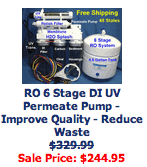
Diagram – 6 Stage RO + UV + Permeate Pump
Posted by: | Comments Diagram of 6 Stage Reverse Osmosis system with UV and Permeate Pump
Note: Click on the PDF emblem and you will be transferred to the diagram
Please review this diagram of this 6 Stage Reverse Osmosis system and should you need additional information you can find assistance on this web site at Reverse Osmosis Instillation Instructions.
Diagram- 7 Stage RO + DI + UV
Posted by: | Comments Diagram of 7 Stage Reverse Osmosis system with DI and UV
Note: Click on the PDF emblem and you will be transferred to the diagram.
Please review this diagram of this 7 Stage Reverse Osmosis system and should you need additional information you can find assistance on this web site at Reverse Osmosis Instillation Instructions.
Diagram RO 4 stage with Booster Pump
Posted by: | Comments 4 Stage RO system with Booster Pump
Please review the diagram for this 4 Stage Reverse Osmosis system with a Booster Pump and should you have additional questions, refer to the Reverse Osmosis Installation Instructions in the same web site.
How do I install a Permeate Pump to my RO system?
Posted by: | CommentsAnswer:
You will mount the Permeate Pump on the wall next to the Reverse Osmosis system. The Permeate “out” on the membrane housing (good RO water) will go to the Permeate “in” on the Permeate Pump. The Permeate “out” from the Permeate pump will go to the Permeate “in” on the ASO valve.Currently (before you install the new Permeate Pump) the blue tubing goes from the Permeate “out” on the membrane housing directly to the “in” on the ASO valve. What you are doing is installing the Permeate Pump between the membrane housing and the ASO valve.
Now for the drain line. Just as in the situation of the good RO water, the drain water is routed through the Permeat Pump. So from the membrane housing “out” for drain water, you run the black tubing from the membrane housing to the “in” for the drain on the Permeate Pump.Then from the “out” for the drain on the Permeate Pump, the black tubing goes to your drain saddle.
For addition information and diagrams, go to our “Permeate Pump Installation Instructions” on our web site www.waterfilteruniversity.com
How do I stop my Reverse Osmosis faucet from dripping?
Posted by: | CommentsBackground:
The standard RO faucet has an adjustment to correct a drip from the faucet spout. The following steps will provide a guide for adjustment of the faucet.
1. Grip the faucet spout and pull it up out of its holder position.
2. The lever that you use to dispense water from the faucet – push it towards the opening where the faucet spout was removed from.
3. Turn the brass headed adjustment ½ turn counterclockwise.
4. Reinstall the lever by sliding it back over the brass headed adjustment bolt.
5. Re insert the faucet spout into its holder position on the faucet base.
6. If when you activate the lever on the faucet a drip continues, repeat the above steps.
Question: How do I install my Self Piercing Valve ?
Posted by: | CommentsAnswer:
When installing the “Self Piercing Tap Valve” on copper lines be certain to install it in-line after the cold water shut-off valve (never install on the hot water line). Mount and tighten the “self piercing valve” on the copper line in a easy to reach location. Turn the saddle valve clockwise all the way in. This will drive the sharp end of a sharp metal pierce into the copper tubing and will pierce a tiny hole. When the saddle valve has been turned all of the way in, the valve is in the “off” position for your new RO system. Do not do anything further with the saddle valve at this time. Leave it like this until later in the installation process.
CLICK HERE FOR COMPLETE REVERSE OSMOSIS INSTALLATION INSTRUCTIONS.
Question: How do I start my RO SYSTEM ?
Posted by: | CommentsAnswer:
Step 1 – Shut the storage tank valve off to avoid any water from entering the storage tank. Then turn on the cold water supply valve to the sink. Check for leaks around self piercing valve.
Step 2 – Open R.O. faucet on sink. Then open valve on the self piercing valve to turn on water to the RO system. You will hear water gurgling as it fills the RO system. It may take up to 15 minutes before dripping out of the faucet and at first the water may be black because of the carbon filter (s). Let water drip out of faucet for 15 minutes and then close faucet.
Step 3 – Open the ball valve on storage tank. If this is a new RO system, you will need to let the tank fill for 6 to 10 hours – depending on the RO membrane capacity. Then open the RO faucet which you installed previously. Drain the tank completely – possibly 15 to 20 minutes. Close the RO faucet and repeat this procedure two more times before using the water for drinking purposes. If you are changing filters, your tank will likely already be full, so you can open the faucet and empty the storage tank. Then proceed to rinse the tank two more times.
Step 4 – Check for leaks frequently during the first week and then occasionally thereafter.
CLICK HERE FOR COMPLETE REVERSE OSMOSIS INSTALLATION INSTRUCTIONS
Question: Why does a Reverse Osmosis system send water to the drain?
Posted by: | CommentsAnswer:
There is a percentage of water from a RO system that goes to the drain. This water is carrying away the impurities. These particles are too small to be caught by filters. Our RO systems have an automatic shut-off valve that shuts off the flow of water to the drain when the storage tank is full. This ASO valve stops the RO system from continuously running water down the drain, thus conserving via the RO system working only according to usage.