Author Archive
Question: Why is my Booster Pump making so much noise?
Posted by: | CommentsAnswer:
1) Entrapped air can cause extra noise in the operation of the Booster Pump – this entrapped air will eventually dissipate over time.
2) Over time, water may have damaged bearings or other motor components. Check for internal leaks.
CLICK HERE FOR ADDITIONAL INFORMATION ON “TROUBLE SHOOTING” DATA AND INSTALLATION INSTRUCTIONS.
Question: Where is the best place to install my Booster Pump?
Posted by: | CommentsAnswer:
The best location for a Booster Pump would be on the Reverse Osmosis system if there is sufficient space to add the pump on the bracket. If there is not the necessary space available on the bracket, then we would suggest the following;
1) Pump must be located within 2 feet of pressure switch
2) Pump must be located within 6 feet of power outlet.
3) Pump can be mounted to the wall horizontally in either
direction or vertically only one way ~ with pump head and
fittings down.
4) Pump can sit on floor or shelf on it’s feet
5) As noted above, the pump can be mounted on the Reverse Osmosis bracket if
sufficient space is available.
CLICK HERE TO SEE MORE DETAIL INSTRUCTIONS FOR THE BOOSTER PUMP.
Question: How do I install my Booster Pump?
Posted by: | CommentsAnswer:
Several of the Reverse Osmosis systems that we offer have the Booster Pump installed and the plumbing is complete, these RO systems do not require you to do additional plumbing or installation.
If you are adding a Booster Pump to your existing Reverse Osmosis system, below is an outline of the steps for you to follow;
1) Mount the Booster Pump on the wall near your Reverse Osmosis system.
2) Insert a “tee” in the 1/4″ tubing between the last pre-filter and the ASO Valve.
3) From that “tee” run a 1/4″ piece of tubing to the inlet on the Booster Pump.
4) Next, run a 1/4″ piece of tubing from the outlet on the Booster Pump to the inlet on the ASO Valve.
5) Insert the Booster Pump Switch into the 1/4″ tubing after the ASO valve
CLICK HERE FOR MORE DETAIL INSTALLATION INSTRUCTIONS FOR THE BOOSTER PUMP.
Question: – What makes a good carbon block cartridge?
Posted by: | CommentsAnswer:
Perhaps the two most important considerations would be pore size and chlorine capacity. The smaller the pore size, the greater protection the carbon block offers you through your Whole House unit or your RO membrane. But remember the smaller the pore size the more impact the carbon block filter will have on your gpm flow (gallons per minute). Carbon block cartridges with a pore size of 5 or 10 microns are the most common in the industry. Carbon blocks with smaller pore sizes will remove additional particles but are generally not necessary if the carbon block filters are being used as pre-filters for a RO system. As for chlorine capacity, most replacement filters have a 6,000 to 8,000 gallon (and much greater in large filters) chlorine removal rating. Most original equipment manufacturers will install carbon filters with a 2,000 to 4,000 gallon chlorine removal rating. Because your sediment cartridge should be in line ahead of the carbon block, the primary purpose of the carbon cartridge (the work horse of filters) is to remove VOCs – volatile organic compounds, and specifically we really want to remove chlorine.
Question: Why are filters described in terms of “microns?
Posted by: | CommentsAnswer:
Filters are commonly described by the size of the pores in the material that makes up the given filter. This stated pore size is the maximum size particle that will flow through a filter. A micron is 1/1,000,000th of a meter or approximately 0.00004 inches. Manufacturers rate filters based upon this pore size, however there is no industry standard technique to express the ratings. Some manufacturers/retailers claim filter ratings expressed using “nominal” numbers. Others claim filter ratings using “absolute” numbers. Many (most) don’t tell you which rating system they are claiming. For example, a 5 micron absolute filter removes a very high percentage (approaching 100.0%) of particles 5 microns or larger; while a 5 micron nominal filter will remove approximately 85% of particles 5 microns or larger.
Question: How do I Install a Quick Connect Fitting?
Posted by: | Comments

Quick Connect Fitting
Answer: Across a host of applications, “quick connect” products require no special tools. Simply cut the tube square and insert it into the fitting to effect a secure and reliable connection. Thus, this type of fitting has become the water industry’s most popular fitting products because they offer the most reliable and cost effective solution to tubing connections. Above is a diagram of how to install “quick connect” fittings. We have displayed the Mur-lok diagram, however these instructions are applicable to all “quick connect” fittings regardless of the manufacturing brand.
Insert tube into fitting
Push the tubing through the collet and O-ring until it bottoms out against the tube stop. The collet holds the tube in place and the O-ring provides a leak resistant seal.
Test and inspect
Push and pull the tubing toward and away from the fitting to ensure that it has been installed properly. Test and inspect the installation for any leaks.
Tube Removal
Relieve pressure from the tubing and fitting. Push uniformly around the collet flange against the fitting body while pulling the tubing away from the fitting to release it.
Question: How do I Install a Jaco Fitting?
Posted by: | Comments
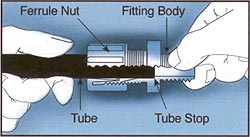
Jaco Fitting
Answer:
1. Cut the tubing end squarely and remove the internal and external burrs.
2. Insert the tubing through the back of the nut all the way through the nut assembly to the tube stop in the fitting body. If the tubing does not enter the nut easily, loosen the nut one turn and then insert the tubing all the way to the tube stop in the fitting body.
3. Turn the nut hand tight.
4. Wrench tighten the nut 1-1/2 to 2 turns.
5. All nuts must be re-tightened when the system reaches projected operating temperature.
NOTE 1: It is not necessary to disassemble this fitting for application. Merely insert tubing to stop and tighten seal.
NOTE 2: Squeaking sound when tightening nut is normal. For pipe threaded connections, Teflon Tape must be used.
Question: Can I upgrade my Reverse Osmosis Faucet?
Posted by: | Comments
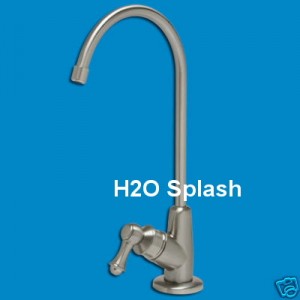
Ceramic Disk Faucet
Answer: Yes, you can upgrade your RO faucet when you purchase a system or at a later date.
At time of RO purchase: Send us an email and indicate the faucet you wish to upgrade to and we’ll get back to you with the price differential.
Purchase at a later date: All of the faucets we offer on our web site can be installed as replacement faucets on Reverse Osmosis systems.
The picture to the right is of a popular upgrade style faucet.
Click here to get Faucet installation instructions
Question: Can the RO Drain Line go to a floor drain?
Posted by: | CommentsAnswer: Yes, you can connect the 1/4″ tubing to the elbow fitting on the membrane housing and the tubing can go directly to a floor drain. This would be a good drain alternative if you are installing the RO system in the basement. We would suggest that you secure the 1/4″ tubing to the drain to avoid any possible floor spills and mess on the floor.
Question: How do I Install the Drain Saddle?
Posted by: | CommentsAnswer: Sink With A Disposal – Best choice is the vertical pipe above the horizontal pipe from garbage disposal.
Sink Without A Disposal – It is best to choose the vertical sink drain pipe at a height as high above the water level in the trap as possible. The drain line may also run directly into a laundry tub or open floor drain. Remember, the drain line can run uphill for several feet. Position the drain saddle away from the dish washer drain to avoid any possible conflict.
H2O Splash Installation Instructions – Drill a 1/4″ hole through one side of the drain pipe. Be careful to remove any “burrs” after you have completed the drilling. Position the gasket over the center of the hole between pipe and drain saddle. Then position the hole in the drain saddle directly over the hole in the drain pipe. Firmly tighten the screws on the drain saddle while maintaining the proper position of the drain saddle on the pipe.