Author Archive
Pleated/Washable Filters
Posted by: | Comments
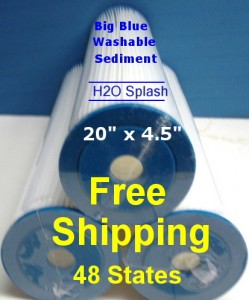
- Big Blue 20″ Pleated/Washable
Answer:
The difference is the media. Not all pleated filters perform the same.
The cellulose free, synthetic filter media allows the pleats to handle higher solids loading and flow rates with a lower pressure drop that increases the filter efficiency and life, while reducing the filter change out cost and frequency.
Competitive cellulose blended pleats collapse on one another, binding off large amounts of the filters surface area. Premature binding of the surface area reduces the flow capacity and efficiency while it raises the differential pressure, and contributes to a limited filter life and frequent filter change cost. .
Question: What makes some Pleated Filters better than others?
Posted by: | Comments
- Big Blue 20″ Pleated/Washable
Answer:
The difference is the media. Not all pleated cartridges preform the same!!
The cellulose-free, synthetic filter media allows the pleats to retain their form, maintaining a large amount of surface. This allows the cartridge to handle higher solids loading and flow rates with a lower pressure drop that increases the filter efficiency and life, while reducing filter change out costs and frequency.
Competitive cellulose blended pleats collapse on one another, binding off large amounts of the cartridge surface area. Premature binding of the surface area reduces the flow capacity and efficiency while it raises the differential pressure, and contributes to a limited filter life and frequent filter change costs.
Question: How much space does a Reverse Osmosis system require?
Posted by: | Comments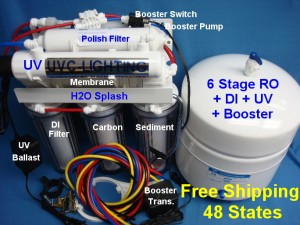
Six Stage RO System
Answer:
Three or Four Stage RO System
The space required for a Reverse Osmosis system will vary with the type of model you will be purchasing. A 3 or 4 stage system will be approximately 14 inches wide, 7 inches deep and 14 to 17 inches tall. The height will vary depending upon the items you stack on top of the RO membrane housing. The storage tank is 16 inches tall and 11 inches in diameter. The RO system and the Storage Tank can be positioned in opposite corners of the under-sink area – they do not need to be placed side by side.
Five, Six or Seven Stage RO Systems
A 5, 6 or 7 stage RO system will be 17 inches wide, 7 inches deep and 17 to 19 inches tall. The number of options you add to the system will determine the height of the unit.The same comments about positioning the unit under the kitchen sink for the three and four stage systems will apply here.
Additional Information
Reverse Osmosis systems can be positioned in the basement or in an adjacent room provided the distance from the RO faucet or refrigerator is no more than 25 to 30 feet. Should your placement situation require greater than 25 to 30 feet, you should install 3/8″ tubing as well as considering a Booster pump and/or a Permeate pump. Both of these pumps will increase the RO systems efficiency as well as increasing the pressure to move the purified water a greater distance to your faucet or refrigerator.
Question: How Do I Replace The Post Carbon Filter?
Posted by: | CommentsAnswer:
Post Carbon Filter – Release the quick-connect fitting from both ends of the in-line post filter and remove the tubes. If your system has FPT fittings, you will need to unscrew and remove the quick-connect fittings from the in-line filter. Discard old filter. Again if your system has FPT fittings, you will need to wrap the threaded end of the quick-connect fitting with Teflon tape and re-install into each end of the new post filter. Tighten the threaded end of the fitting into the ends of the new filter. Note: If your post carbon filter has quick connect fittings build into the filter, you do not need to unscrew the fitting and then wrap it with Teflon, you simply remove the tubing from the old filter and the insert the tubing into the new post filter. Be certain the arrow on the new filter is pointing with the flow of the water toward the tubing leading to the faucet.
Question: How Do I Replace The Pre-Filters On My RO System?
Posted by: | CommentsAnswer:
Sediment and Carbon Pre-filters – Turn the valve off on self piercing valve (or other inlet source for the incoming water). Next, turn the ball valve off on the storage tank. Open the R.O. faucet at the kitchen sink (or wherever you installed it) to de-pressurize system. Unscrew filter housings by turning counter clock wise (for easy servicing, be certain to use your housing wrench) – NOTE – remove only one housing at a time so you do not mix the housings or type of filter. Remove the old (depleted) filter and discard. Clean the filter bowl with warm soapy water. Then rinse and add one table spoon of liquid household bleach and fill the housing with water. After letting it stand for 5 minutes, empty the housing and rinse well with tap water. Insert the replacement filter into the housing. Do not touch the filter. By using the wrapper to handle the new filter your hands will not induce bacteria that will grow and foul the water. Inspect the “O” rings and replace as necessary. Hand tighten and use a wrench only if the housing leaks. If you are replacing the post carbon filter and or the RO membrane, complete those replacements at this time. If you are only replacing the pre-filters, then turn the incoming water on and fill the storage tank. When the storage tank is full, turn the faucet on and drain the storage tank. This will remove the fines that may be in the water from the start up on the new carbon filters.
Answer: Color changing DI resin has a water soluble dye that will change its color and thereby yield a general indicator when the resin is exhausted (depleted). We offer both color indicating (i.e., Color-Changing) resin, and non color indicating resin (Nuclear). They are identical resins except for the dye. Bear in mind that the color-changing feature as a very general indicator only. You can commonly continue to use the resin (depending on usage) for weeks or months after it begins to change color. It is best to use a TDS meter to monitor how well the resin is performing, and when it’s time for a new resin refill. Although there are no known harmful effects of the dye, we would suggest that you use the non-color changing dye if you have the availability of a TDS meter.
Question: What does Deionization/Demineralization (DI) mean and what is its purpose?
Posted by: | CommentsAnswer: Demineralization by Ion Exchange. DI is a mixed bed of resins which attract ions, salts or minerals and can entirely remove the metals and salts from your water. If your Reverse Osmosis system removes (95 – 98 %) of the minerals and salts, then you could follow it up with a D.I. cartridge or a D.I. in-line filter to remove almost 100 % of the TDS (Total Dissolved Solids), which would render your water with a TDS of near zero ppm. Your RO membrane rejection percentage will have a direct impact on the life of your DI cartridge or DI in-line filter. The DI will absorb everything in the water that is left behind by the RO membrane. Therefore, if your water usage requires a product with a zero (0) TDS, DI is the answer.
Question: What Is The Recommended Filter Service Life/Replacement?
Posted by: | Comments
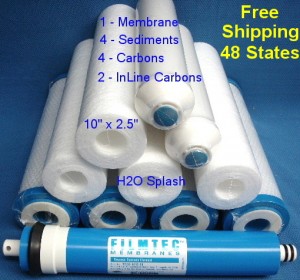
RO Membrane/Filter Package
Answer:
Sediment Pre-Filter – It is best to change a sediment filter every 6 months to a year (more frequently when there is a high level of dirt and rust present in the water).
Carbon Pre-Filter – It is best to change a carbon filter every 6 months to a year. Proper pre-filter maintenance will help insure membrane life and water quality.
R.O. Membrane – The R.O. membrane can last up to 5 years (and longer) with proper maintenance. When the rejection rate falls below 85% it is best that you replace the RO membrane. With the use of a TDS (Total Dissolved Solids) meter, the rejection rate should be tested every 6 months (more frequently if you have a high TDS count in your incoming water). The frequency of TDS testing should increase as the RO membrane ages. This allows you to compare the amount of TDS in the incoming water vs. the drinking water.
Carbon Post Filter – This is the polishing filter for the RO system and therefore you should maintain it for providing you the best water possible. Change this filter every 6 months to a year and this will insure quality water and don’t wait until taste is a problem.
DI Resin – DI resin is available in both regular nuclear grade and color changing. Both will provide the same quality of water (zero TDS). Even when you are using color changing DI, it is advisable for you to use a TDS meter for an accurate assessment of your water quality. If your water usage requires the extra pure water that is achieved with DI, then you should be prepared to replace the DI resin when the TDS count reaches 5 to 6 TDS.
Reverse Osmosis systems require periodic maintenance to insure you are getting the water quality that your usage requires. The most important maintenance is your timely filter changes. Filters require replacement at recommended intervals because they retain large amounts of debris and contaminants. Failure to change filters (and replace them with quality filters) can reduce membrane life and water quality dramatically. Remember, most contaminants don’t have a foul taste except in extreme quantities. As noted previously, don’t wait until you have bad tasting water before you make filter changes.
Question: What Are The Features Of A Carbon Block Filter?
Posted by: | CommentsAnswer: Solid Carbon Block filters have combined the incredible adsorption capability of carbon, with the ability of a solid block of material to selectively strain out particles from water that is forced through it. The density of the carbon block determines how finely the water is cleaned. This type of filter is designed to prevent any possibility of bypass due to high water pressure.
The block of carbon mechanically strains out dirt, sediment, rust, algae, bacteria, microscopic worms, cryptosporidium and asbestos. This is all accomplished by water pressure. The compacted solid carbon block filter is designed to mechanically filter particles down to sub micron size. By microstraining the water, the consumer is assured that only the cleanest, clearest water is delivered to the point of use. Activated carbon bonds to thousands of chemicals. In fact, carbon will bond to most chemicals known! When water is forced through the solid carbon block, it is forced to slow down and increase the contact time with the carbon, allowing the carbon bonding to take place to remove the chemical pollutants like toxins, pesticides, THM’s, chlorine, bad tastes, odors, etc. Heavy metals like lead do not bond to the carbon, but are strained out by the pore size of the block. Basically, it’s like trying to put a basketball through a hole the size of a golf ball.
Whole House Installation Instructions
Posted by: | Comments  Click on PDF to download the Whole House Installation Instructions