Author Archive
UnderCounter Installation Instructions
Posted by: | Comments  Click PDF to download the UnderCounter Installation Instructions
Permeate Pump Installation Instructions
Posted by: | Comments Click PDF to download Permeate Pump Installation Instructions
Answer: Depending on the contaminants in your water, the difference could be like night and day. Sediment filters are designed to take out dirt particles. Sediment filters do not take out chemicals etc. The purpose of a sediment filter in a dual whole house is for the sediment to get the larger particles out so the carbon block filter can do its work. Activated carbon has an electro-positive charge added which results in this type of carbon attracting more chemicals and impurities. As the water passes through the positively charged carbon, the contaminants with their negative ions, are attracted to the carbon granules and thus extracted from the water. The block of carbon strains out sediment, dirt, bacteria, microscopic worms, algae, asbestos and cryptosporidium. With just water pressure, this compacted solid carbon block is designed to filter sub micron size particles. This microstraining of the water will provide the cleanest and clearest drinking water available.
Activated carbon bonds to thousands of known chemicals. As water is forced through this solid block of carbon, it is forced to slow its flow speed and thereby increase the contact time with the carbon. This slowing of the flow allows the carbon bonding to take place and remove chemical pollutants like toxins, THM’s, chlorine, pesticides, bad tastes, odors, etc. As you can tell, the responsibilities of the two filters is quite different. You need to make the choice based on what you need and want to get out of your water.
Differences between a Carbon Block and a GAC
Solid Carbon Block Filters are exceptionally uniform and do not channel or bypass as conventional granular activated carbon (GAC) filters are known to do. Because of the density of the solid carbon block, there is no room for bacteria to grow so this type of filter does not become an incubator for bacteria as GAC filter is known to be.
Question: What are the differences between various types of carbon filters?
Posted by: | CommentsAnswer: The differences are primarily in the filters and sumps used. Cheap carbon filters use a couple of ounces of carbon sprayed on a wax like paper that is rolled up and covered in netting. There isn’t very much carbon present, hence a short effective life. Granular activated carbon (GAC) filters can channel. This is when the water finds a path of low resistance and much of the carbon is bypassed. When used as pre filters for a Reverse Osmosis system or for a Whole House filter, the best type of carbon filter available today is the extruded carbon block. The carbon is ground into a fine powder, then pressed into a block under millions of pounds of force. The pore size can be controlled to the micron level. When one pore clogs, the water has thousands of other pores to travel through. This gives maximum water to carbon contact and maximum use of the carbon. The differences in sumps relates primarily to the size of the inlet and outlet and the impact of these size variances on the flow through the filters.
Question: What are the Basis Components of a Reverse Osmosis System?
Posted by: | CommentsAnswer:
1. Cold Water Line Saddle Valve: Saddle Valve that fits onto the cold water supply line. The saddle valve has a piercing needle that penetrates into the cold water line to supply the water for the RO system.
2. Pre-Filter (s): Water from the cold water supply line enters the RO pre filters first. There are two or three pre-filters used in a reverse osmosis system. The first pre-filter used will be a sediment filter. This filter is used to remove sand, silt, dirt and other sediment. Next is a carbon block filter which is used to remove chlorine and chemicals from the incoming water. When a RO system has 3 pre-filters, the third filter will also be a carbon block filter.
3. Reverse Osmosis Membrane: The reverse osmosis membrane is the heart of the system. The most commonly used is a spiral wound TFC membrane (thin film composite/material). CTA (cellulose tri-acetate) can be used when carbon block pre-filters are not required, however this type of membrane is not very popular in today’s environment.
4. Post filter (s): After the water leaves the RO storage tank, but before going to the RO faucet, the product water goes through the post filter (s). The post filter is carbon (either in granular or carbon block form). Any remaining tastes and odors are removed from the product water by post filtration.
5. Automatic Shut Off Valve (ASO): To conserve water, the RO system has an automatic shutoff valve. When the storage tank is full (this will vary based upon the incoming water pressure) this valve stops any further water from entering the membrane, thereby stopping water production. By shutting off the flow this valve also stops water from flowing to the drain. Once water is drawn from the RO drinking water faucet, the pressure in the tank drops and the shut off valves opens, allowing water to flow to the membrane and waste-water (water containing the contaminants) to flow down the drain.
6. Check Valve: A check valve is located in the outlet end of the RO membrane housing. The check valve prevents the backward flow of product water from the RO storage tank. A backward flow could rupture the RO membrane and of course it will empty the storage tank.
7. Flow Restrictor: Water flow through the RO membrane is regulated by a flow control. There are many different styles of flow controls. This device maintains the flow rate required to obtain the highest quality drinking water (based on the gallons per day capacity of the membrane). It also helps maintain pressure on the inlet side of the membrane. Without the flow control very little drinking water would be produced because all the incoming tap water would take the path of least resistance and simply flow down the drain line. The flow control (restrictor) is located in the elbow fitting on the membrane housing where the RO drain line tubing is attached.
8. Storage Tank: The standard RO storage tank holds up to 4.5 gallons of water. A bladder inside the tank keeps water pressurized in the tank for dispensing to your faucet and/or refrigerator ice maker.
9. Faucet: The RO unit uses its own faucet, which is usually installed on the kitchen sink. Be certain you install the faucet where it will not interfere with other sink faucets and the outlet of the neck of the RO faucet is over the sink.
10. Drain line: This line runs from the outlet end of the reverse osmosis membrane housing to the drain. This line is used to dispose of the impurities and contaminants found in the incoming water source (tap water).
Booster Pump Installation Instructions
Posted by: | CommentsQuestion: What Contaminants are Removed by-Filters/RO Membranes/DI?
Posted by: | CommentsAnswer: DI Cartridges and In-line DI Filters: Deionization removes ions (heavy metals or salts) dissolved into the water. RO membranes: Membranes remove bacteria, virus, metals, salts (ions). Carbon Filters: Carbon block filters absorb chlorine, chemicals and filter particulate matter. Sediment filters: Sediments filter out particulate matter only.
The top quality water purification system is built in this manner: Sediment filter: designed to remove large sediment and particulate matter from the water. The sediment filter should have as large a micron rating as practical, we suggest ten micron. The stage two (2) is a carbon filter. This is where chlorine and most of the chemicals are removed from the water. There are many different carbon filters on the market. The best carbon filters are block type. We recommend a coconut carbon block and in stage two (2) we recommend a rating of five micron. In a properly designed system there will be a second carbon stage – pre-filter number three (3). We recommend a one micron coconut carbon block filter. Why two carbon filters? Just ask any one about chloramines and ammonia leakage. With today’s environmental concerns, in many areas one carbon systems are not achieving a satisfactory removal of sediment and chemical particulate matter. The membrane stage is where all of the real work is done. The membrane pores are hundreds of times smaller than a one micron filter. This is the first stage of the system to impact the bacteria, virus, pathogens, endotoxins and the TDS (total dissolved solids). The pre-filters, even if you use all one micron, have no impact on the TDS of the finished water. RO membranes are generally rated to remove 95% to 98% of the dissolved metals and salts in the water. Of course that 95% to 98% is when the RO membrane is new. Over time, that percentage begins to drop, leaving more and more for the DI to remove. We suggest that you replace your RO membrane when the TDS of the water coming from the membrane drops below the upper 80% range. If you let your RO membrane continue to operate below the upper 80% range,you will be using DI resin at a much faster rate because the DI resin will continue to gather in what gets passed the RO membrane and correspondingly the DI resin will become saturated much more quickly. Next, the DI. The ion dissolved metals and salts that are missed by the membrane are captured by the DI resin. Provided you monitor your finished product water, you will know when the DI resin has gathered in all that it can hold and it is time to replace the DI resin. So a properly designed RO/DI system provides sediment, bacteria, chlorine, chemical, virus, and dissolved metals free water. Just about as close to pure as you can get. Nothing provides more protection for your water at any where near the cost of production nor is as environmentally friendly. RO/DI = ZERO.
Question: Who Should Consider Purchasing A Reverse Osmosis System?
Posted by: | CommentsAnswer: Anyone concerned about the quality of their home drinking water — particularly if they notice taste or odor problems or are aware of high levels of dissolves minerals in their water supply — should consider an RO system. Additionally, RO systems often are recommended for immune-comprised individuals who could be especially susceptible to infection from various waterborne contaminants. The Centers for Disease Control and Prevention (CDC) recommends Reverse Osmosis as a method for removal of a dangerous microorganism cyst called Cryptosporidium. Reverse osmosis systems, which include both a RO membrane and pre-filters and post-filters, offer a comprehensive means of eliminating more than 90 percent of potentially harmful contaminants in home drinking water.
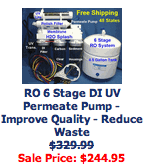
Essentially all RO membranes produce similar, highly purified water. However not all systems offer the same features. For example: The choice of RO system will depend on the level of contaminants in your water and what those contaminants consist of in the incoming water. If you are on municipal water and there are no known highly toxic or bacteria related contaminants in the water and your incoming PSI is 50 or greater, perhaps a 5 stage system would meet your requirements. This unit has five stages, meaning the water passes through a sediment polypropylene pre-filter, then two solid carbon block pre-filters for chlorine and chloramines removal, then the RO membrane to remove the smallest of contaminants, and finally another carbon filter to polish the taste. If you prefer a water conservation design, then you should consider adding a highly efficient Permeate Pump. This provides a non-electric permeate pump that utilizes the drain flow to reduce the back pressure from the storage tank allowing a more consistent working pressure across the membrane. Should your incoming water have less than 50 PSI, you should consider the addition of a Booster Pump as pressure is the most important factor for a RO system in the production of water quality and quantity. Other factors for consideration in the selection of a Reverse Osmosis system would be the presence of bacteria, high levels of metals and the need for ultra clean water. Send us an email should you need assistance in making a model selection.
Question: How Difficult Is A Reverse Osmosis System To Install?
Posted by: | CommentsAnswer: Any person who knows how to use a screw driver, an adjustable wrench and a drill, can install a Reverse Osmosis system.
Click HERE for installation instructions.
We ship our RO Systems assembled and with the in-depth installation and maintenance manual noted above, you will be able to complete the installation very quickly. You will not need to solder or cut pipes. The system hooks in to the existing plumbing under your kitchen sink with a quality adapter or a self-piercing saddle valve. These special fittings will allow you to install the system without cutting or soldering your pipes. The system is plumbed with QUICK CONNECT fittings and tubing which are FDA approved color coded and high pressure capability. The unit with these QUICK CONNECT fittings will allow you to just push the supplied tubing into them and they lock and seal automatically.
Question: How do I know if I have a ruptured bladder in my storage tank?
Posted by: | CommentsRUPTURED AIR BLADDER IN TANK:
Reverse Osmosis tank bladders do fail, requiring replacement of the tank. If the bladder in the storage tank starts to leak air, and water enters the air side of the bladder, the tank will have to be replaced. As described above, open the faucet and drain all of the water from the tank. When you pick the tank up, if the tank feels heavy as if it is full even though you can’t get water out of the faucet, the bladder is ruptured. The air stem may show signs of dampness from the water that passed to the air side of the bladder. We offer Replacement RO Tanks.