Author Archive
Question: What will a Booster Pump do to improve my Reverse Osmosis System?
Posted by: | CommentsAnswer: A Booster Pump will provide increased pressure for the incoming water which will result in the Reverse Osmosis system to operate more efficiently. The increased water pressure will force more purified water through the membrane into the storage tank and at the same time send more contaminants to the drain. This increased pressure will also increase the pressure in the storage tank and this will result in a better flow from the storage tank to the faucet.
Question: Why do I need a Booster Pump?
Posted by: | CommentsAnswer: The greater the water pressure, the better the quantity and quality of the water produced by a Reverse Osmosis system. Water pressure of 60 psi is ideal. To maintain a constant 60 PSI you should consider including a booster pump. It is the pressure of the incoming water that forces the water through the membrane for purification and flushes the rejected solids away. Low water pressure will result in reduced production and premature fouling of the membrane. The ideal pressure for operating an RO System, as noted above is 60 PSI. Pressure below 40 PSI is generally considered insufficient, and should be boosted using a pressure booster pump.
Question: How do I Install my Reverse Osmosis Faucet?
Posted by: | CommentsAnswer: H2O Splash Instructions – Frequently there is an extra hole for the mounting of sprayers, various types of dispensers or even adding an extra faucet. Should your sink not have an additional pre-drilled hole, use the following procedure. Select a Location for the Faucet. Start by checking under the sink to make sure there is sufficient space and there are no obstructions. Position a pan under sink to catch any metal filings and thereby avoid a clean up mess.
Stainless Steel Sink : Do some measuring to insure that you will be locating the new faucet a sufficient distance from the existing faucets to allow all of the faucets to rotate in a proper working fashion. Be certain there will be adequate space to secure the lock nut. With a center punch, make an indentation in sink surface where you have selected the spot for the new faucet. This indentation will help hold alignment of hole saw. Drill a of the size indicated in the information you received in the shipping box.
Porcelain Coated Sink : Most manufacturers recommend to have this type of sink drilled by a professional because of potential damage due to chipping or cracking. Should you attempt to drill, use a Relton Cutter with adequate cooling lubricant and exercise extreme care. Should you elect to not drill into the sink, you could install the faucet directly into the adjacent countertop. Be certain to position the faucet at a location that will allow the end of the spout to reach over the sink.
Installing Standard Non-Air-Gap Faucet:
(1) Once the hole is prepared, assemble those parts of the faucet that belong above the sink. First, the faucet spout. Some faucet spouts have threads, most do not. It is not necessary to tighten the faucet spout. It is preferable to let it move freely thereby allowing you to move the faucet out of the way when you need the space. Insert the faucet stem into the hole in the faucet body. No plumber’s putty is needed since the small round rubber washers will provide the seal. (2) The small, flat, black rubber washer goes underneath the faucet body, then the large chrome base plate, and then the large black rubber washer. (3) From under the sink, slide on the thick black plastic washer first, then slide on the locknut & screw on the brass hex retaining nut. Tighten firmly into place once the faucet is properly aligned. If a small adjustment is needed from above, pad the jaws of the wrench, so as not to scratch the chrome finish.
Question: What type of Reverse Osmosis systems are available?
Posted by: | Comments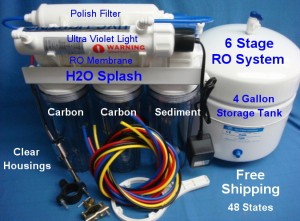
6 Stage Reverse Osmosis system
Answer: We offer a wide range of RO systems from two stage up to seven stage systems plus options within the given stages. To just sight an example, we offer over 30 different models of 5 stage RO systems. We build the Reverse Osmosis systems here in our facility in the USA, therefore we can offer over 100 different RO system models. The information listed below is not specific to any given model but provides a general description of a Reverse Osmosis system. As an example, if your RO system has 3 pre-filters, the comments about carbon filters will relate to both of your carbon pre-filters. The sediment pre-filter is the first vertically mounted filter in a standard 3, 4, 5, 6 and 7 stage RO system (remember, the incoming water enters from the right side of the RO system, so the first vertical housing is the housing on the right). The second vertical filter is a carbon pre-filter in a standard 3, 4 , 5, 6 and 7 stage RO system. The third pre-filter is a carbon in most 5, 6 and 7 stage RO systems. The RO membrane is the lower and larger horizontally mounted housing that has an end cap that unscrews. Mounted horizontally above the membrane housing is the in-line carbon (polish/post) filter on 4, 5, 6 and 7 stage RO systems. The photo above is of a 6 stage RO system which includes a UV light positioned horizontally above the membrane. The 7 stage system also has an in-line DI filter which is mounted horizontally next to the in-line carbon (post) filter. These comments relate to standard RO systems and some non-standard, proprietary systems may vary from this configuration.
Question: Where should I position my Whole House Filter system?
Posted by: | CommentsAnswer:
If you have a water softener, we would suggest that you place the Whole House System after the softener. It is best to let the softener remove the calcium and magn. out of the water prior to the water entering the Whole House filters. This will entend the life of your Whole House filters and allow the carbon filter to work on the chemicals and chlorine in the water.
If you do not have a water softener, then it would be best to locate the Whole House System in a position at the water entry point into the house.
Question: How do I know which size filter to order?
Posted by: | CommentsAnswer:
Industry standard size filters are available in 4 basic filter sizes;
1) 10″ x 2.5″
2) 20″ x 2.5″
3) 10″ x 4.5″
4) 20″ x 4.5″
To determine the size of your filter housing, so that you can purchase the correct filters, remove the sump (lower portion of the filter housing that screws off the cap). Now measure the inside diameter at the top of the sump. If you have either # 1) or # 2) above, your inside measurement will be 3″ to 3 1/2″. The reason you need a 2 1/2″ diameter filter is because the housing tapers as it goes towards the bottom so at the bottom of the sump the inside diameter is very close to the 2 1/2″ measurement. The length of the sump will be approximately 10 1/2″ on # 1) above and the length on # 2) above will be approximately 20 1/2″.
Now to the Big Blue size filters. If you have either item # 3) or # 4) above, the inside diameter will be approximately 5 1/4″. The length of the sump for item # 3) will be approximately 11″ and the length of the sump for item # 4) will be approximately 21″. As with the smaller diameter filters, these Big Blue filter housings taper from top to bottom so the 4 1/2″ diameter filters fit snug at the bottom of the sump housing.
Question: How Do I Replace The Membrane On My RO System?
Posted by: | CommentsAnswer:
R.O. Membrane – Turn the water off at the inlet saddle valve (or supply valve) and open the RO faucet to drain the storage tank. When the storage tank has been emptied, close the RO faucet. Next, close the valve on the storage tank. Disconnect the tubing going into the end of the membrane housing on the end that has only one tube going into it. Once you have removed the tubing, unscrew the end cap of the membrane housing. Have a container in place as water will pour out. Remove the old membrane from the housing (this may take an extra pull as they sometimes fit very tight) and clean the inside of the membrane housing with warm soapy water. Grease the “o” ring with food grade oil. Insert the new membrane in the direction of the arrow on the membrane. The end with the two small “O” rings goes in first on the regular, industry standard membranes. The end with the large rubber ring (brine seal) goes in last, next to the removable end cap. Be certain that the center tube of the membrane is seated properly into the receiver in the bottom of the housing. Push firmly! Screw the end cap back on and reconnect the tubing into the fitting on the end of the membrane housing.
Open the RO faucet. Open the inlet saddle valve (or supply valve) to feed water to the RO system. Do not open the storage tank valve at this time. Allow the water to drip from the faucet for at least 1 hour. This procedure will fulfill the requirement of flushing the RO membrane as may be described on the membrane packaging. After one hour, close the RO faucet and open the storage tank valve. Allow the system to fill the tank and shut off. Then open the faucet and drain the tank. Repeat this 2 more times, for a total of 3 full tanks to fill and then drain. This will flush the preservative from the membrane and remove any black, dirt looking, carbon fines from the water before using the water for drinking or aquarium usage.
Question: What type of bracket should I purchase to mount Big Blue housings?
Posted by: | CommentsAnswer:
Both Big Blue 10″ and 20″ housings are very heavy when filled with a filter and water. Correspondingly, be certain that you purchase a quality bracket that can withstand the weight and thereby avoid damage to the housing as well as damage to your house. Listed below are the three sizes of Big Blue brackets available for 10″ and 20″ Big Blue housings.
One (1) single bracket is used to mount one Big Blue 10 inch or 20 inch filter housing for use as a water filter or a whole house system. This bracket is made of quality steel and painted to a fine finish. This bracket measures 4 1/2 inches wide x 6 5/8 inches deep x 5 inches up on the back and has suitable spacing for pressure release button. This is a very heavy duty bracket
One (1) dual bracket is used to mount two Big Blue 10 inch or 20 inch filter housings on the one bracket for use with water filter or whole house systems. The brackets are made of quality steel and painted to a fine finish. This bracket measures 13 3/4 inches wide x 7 inches deep x 3 7/8 inches up on the back and 1 1/2 inches down on the front and has suitable spacing for pressure release buttons. This is a very heavy duty bracket.
One (1) triple bracket is used to mount three Big Blue 10 inch or 20 inch filter housings on the one bracket for use with water filter or whole house systems. The brackets are made of quality steel and painted to a fine finish. This bracket measures 21 5/8 inches wide x 8 inches deep x 4 inches up on the back and has suitable spacing for pressure release buttons. This is a very heavy duty bracket which weighs nearly 9 pounds.
Question: How will Gauges improve my Whole House System?
Posted by: | CommentsAnswer:
Installation of a gauge on the front side (incoming) of your whole house unit will provide the psi reading of the incoming water and the installation of a second gauge on the back side (out-going) of the wholehouse Water Filter System will provide you with the psi of the out-going water. By making comparison of the two psi readings you will get the differential psi reading which will let you know when to change filters in your system. This will take the guess work out of maintenance in your whole house system.
Question: How will Ball Valves Improve My Whole House System?
Posted by: | Comments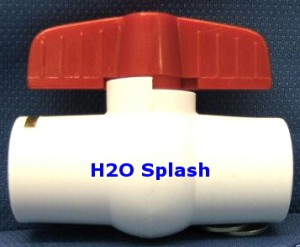
Ball Valve
Answer:
When you have two (2) reinforced heavy duty PVC ball valves (maintenance free and corrosion free) – they can be used on both the inlet and the outlet of a whole house water unit. On the inlet side it can be used to shut off the incoming water supply. On the outlet side of the whole house water filter unit it can be used to shut off the back flow of water from the water pipes located at a higher level and thereby avoid a water spill when changing the filter elements.
We also offer Sea Tech fittings for the do-it-yourself plumber which will insert into the ball valves and make installation easy. We ship the ball valves un-installed to avoid unit damage during shipment.
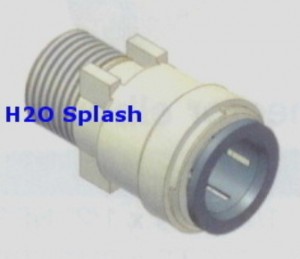
Sea Tech Male Connector