Question: What Contaminants are Removed by-Filters/RO Membranes/DI?
ByAnswer: DI Cartridges and In-line DI Filters: Deionization removes ions (heavy metals or salts) dissolved into the water. RO membranes: Membranes remove bacteria, virus, metals, salts (ions). Carbon Filters: Carbon block filters absorb chlorine, chemicals and filter particulate matter. Sediment filters: Sediments filter out particulate matter only.
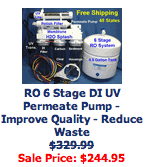
The top quality water purification system is built in this manner: Sediment filter: designed to remove large sediment and particulate matter from the water. The sediment filter should have as large a micron rating as practical, we suggest ten micron. The stage two (2) is a carbon filter. This is where chlorine and most of the chemicals are removed from the water. There are many different carbon filters on the market. The best carbon filters are block type. We recommend a coconut carbon block and in stage two (2) we recommend a rating of five micron. In a properly designed system there will be a second carbon stage – pre-filter number three (3). We recommend a one micron coconut carbon block filter. Why two carbon filters? Just ask any one about chloramines and ammonia leakage. With today’s environmental concerns, in many areas one carbon systems are not achieving a satisfactory removal of sediment and chemical particulate matter. The membrane stage is where all of the real work is done. The membrane pores are hundreds of times smaller than a one micron filter. This is the first stage of the system to impact the bacteria, virus, pathogens, endotoxins and the TDS (total dissolved solids). The pre-filters, even if you use all one micron, have no impact on the TDS of the finished water. RO membranes are generally rated to remove 95% to 98% of the dissolved metals and salts in the water. Of course that 95% to 98% is when the RO membrane is new. Over time, that percentage begins to drop, leaving more and more for the DI to remove. We suggest that you replace your RO membrane when the TDS of the water coming from the membrane drops below the upper 80% range. If you let your RO membrane continue to operate below the upper 80% range,you will be using DI resin at a much faster rate because the DI resin will continue to gather in what gets passed the RO membrane and correspondingly the DI resin will become saturated much more quickly. Next, the DI. The ion dissolved metals and salts that are missed by the membrane are captured by the DI resin. Provided you monitor your finished product water, you will know when the DI resin has gathered in all that it can hold and it is time to replace the DI resin. So a properly designed RO/DI system provides sediment, bacteria, chlorine, chemical, virus, and dissolved metals free water. Just about as close to pure as you can get. Nothing provides more protection for your water at any where near the cost of production nor is as environmentally friendly. RO/DI = ZERO.