Question: How Does Reverse Osmosis Work?
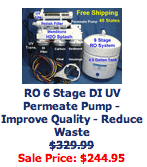
ByAnswer: In modern home RO systems, water driven by normal city water pressure, flows first through a sediment pre-filter which removes dirt and small particles that are in the water, next a carbon block pre-filter, removes organic contaminants including chlorine and its by-products. Then, it enters the reverse osmosis membrane, a very tight, sheet-like filter, that allows water to pass but rejects dissolved solids like sodium and impurities like lead and arsenic. The city water line pressure allows the Reverse Osmosis process to take place. Some of the water entering the unit is used to cleanse the membrane surface and flows to the kitchen drain pipes. The purified water is stored in the storage tank until it is used for your drinking and cooking requirements. When the faucet mounted on the sink is opened, the purified water is forced by air pressure through another carbon post filter, which gives it a final polish and from there to the faucet. (This is a simplified description of a four-stage RO unit. -The simplified description omits a few very essential parts like saddle valve, flow control resctictors, check valves, drain clamps, and automatic shutoff device that stops the inflow of water when the storage tank is full.)